Will Tor allow home relays to join in the future? There are many successful cases about home relays. I hope the development team can develop relays suitable for families in the future.
From what I read, you need a static IP for this. Not many of us have this. Assuming this would work with a dynamic IP, would you then become a target for the censor regimes? I would not want to be on that list.
Another thing I can think of is that most home connections are asymmetric. Much Kbps for incoming (download) but a lot less for outgoing. Most homes operate like this when surfing.
Edited later:
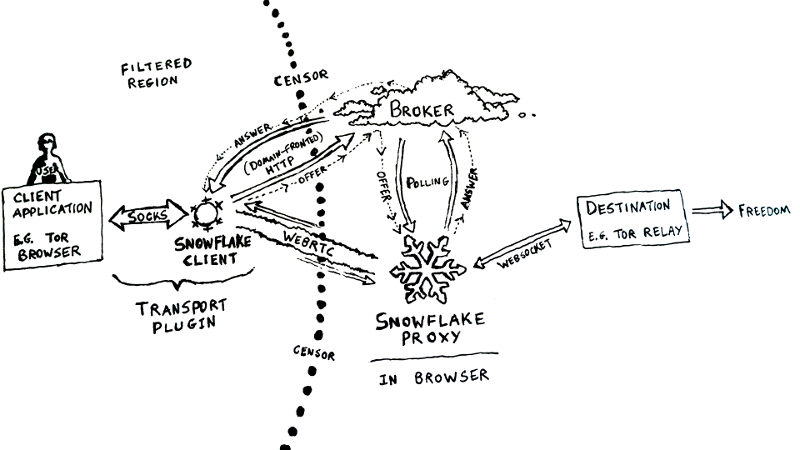
You could operate a Snowflake proxy either using a browser or standalone restricted or unrestricted. I started with a browser was then convinced to give standalone a try. I am still running it now one year later. You are still effectively limited by your upload speed.
Tor already does allow home relays, but there are multiple issues and challenges to consider:
- Since the Tor network is public, your home IP address would be publicly listed as a relay. This can cause to certain websites or online services like online banking and video streaming to block access from your house.
- Tor relays must have a publicly reachable IPv4 address. On residential connection, this usually requires configuring your modem/router to open and forward ports. It can be a significant technical hurdle…
- Residential internet connection can be less stable, which may affect your relay uptime, bandwidth and flags.
That said, contributing with a snowflake standalone proxy seems a better way to contribute with the Tor network using your home connection.
One thing I once theorized about as a thought exercise is a decentralized setup similar to how i2p functions.
The idea was let any instance of a Tor browser act as a node.
Roughly each current entry-node wouldn’t only act as relay, but also as rendezvous-point/STUN server. Each time a Tor client is started it would use UDP hole punching to make itself accessible publicly. The Tor client would make the IP and opened UDP port known to a random Tor entry-node.
Instead of the circuit being build by the current list of Tor nodes, the entry-node could return a circuit by using the list of currently peers by passing three ip:udp-port connections back to the Tor client making the request.
The scheme would be something like this - multiple variations can be made on this (e.g only make middle notes p2p):
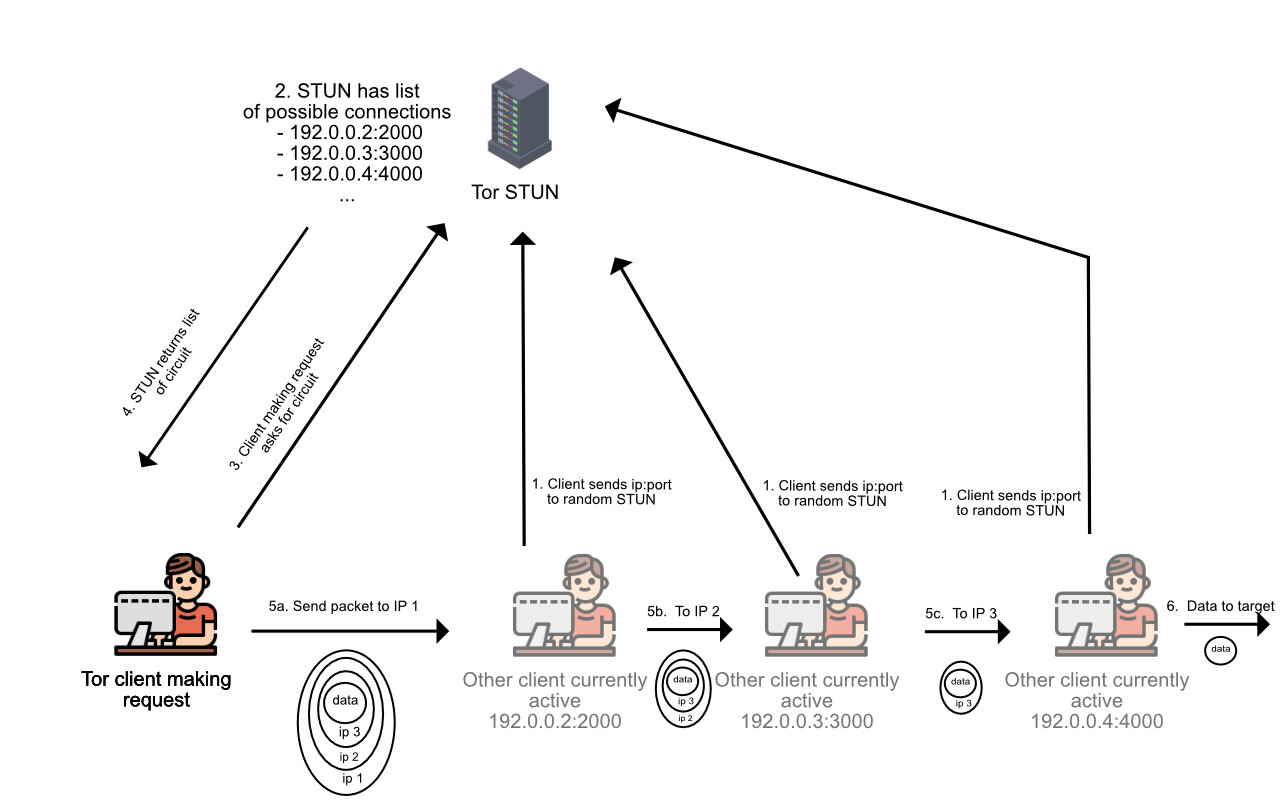
Tor currently is pseudo-decentralized. But this would make it fully decentralized and I’d love to see that.
But don’t expect something like this to be implemented. It conflicts too much with the current protocol workings and philosophy. Snowflake works decentralized though (which is really cool).
If you do decide to, I am more then happy to help and there are others. I am running it on Ubuntu 22.04